

Translated by AI model deepseek-flash.
Source Language: Simplified Chinese, Target Language: english, Translation Time: 2026-10-19 11:16
.AI translation is for reference only. Accuracy is not guaranteed, please refer to the original text.
This article was written with AI assistanceThis article is purely AI-written, human input: 0%
Today at 3
PM, I made a decision: to build my own blog backend.By 10
PM, it was already usable.Just over 5 hours, 17 commits, nearly 700 million Token.
This idea had actually been sitting in my mind for a long time.
Back in 2024, in order to be able to edit my blog online, I struggled with Decap CMS, configuring it step by step from Netlify to Git Gateway. After finishing, I even wrote a hand-holding tutorial.
But honestly, after that thing was configured, I used it a number of times I could count on one hand. The interface wasn't great, it was even harder to use on mobile, and if I wanted to add a field I had to go back and change the config and redeploy. Later the blog moved from Hexo to Astro, I stopped using Netlify's Identity, and Decap just sat there.
So over these years, the way I updated my blog was still the old routine: turn on the computer, open the editor, make changes and push. When I was out, it basically meant no updates.
I kept thinking, when would I have one that's handy for me to use.
Today I finally got to work.
I explained my idea and requirements to the AI, and even seriously wrote a plan.md—it's still in the repo now, and it's written quite convincingly.
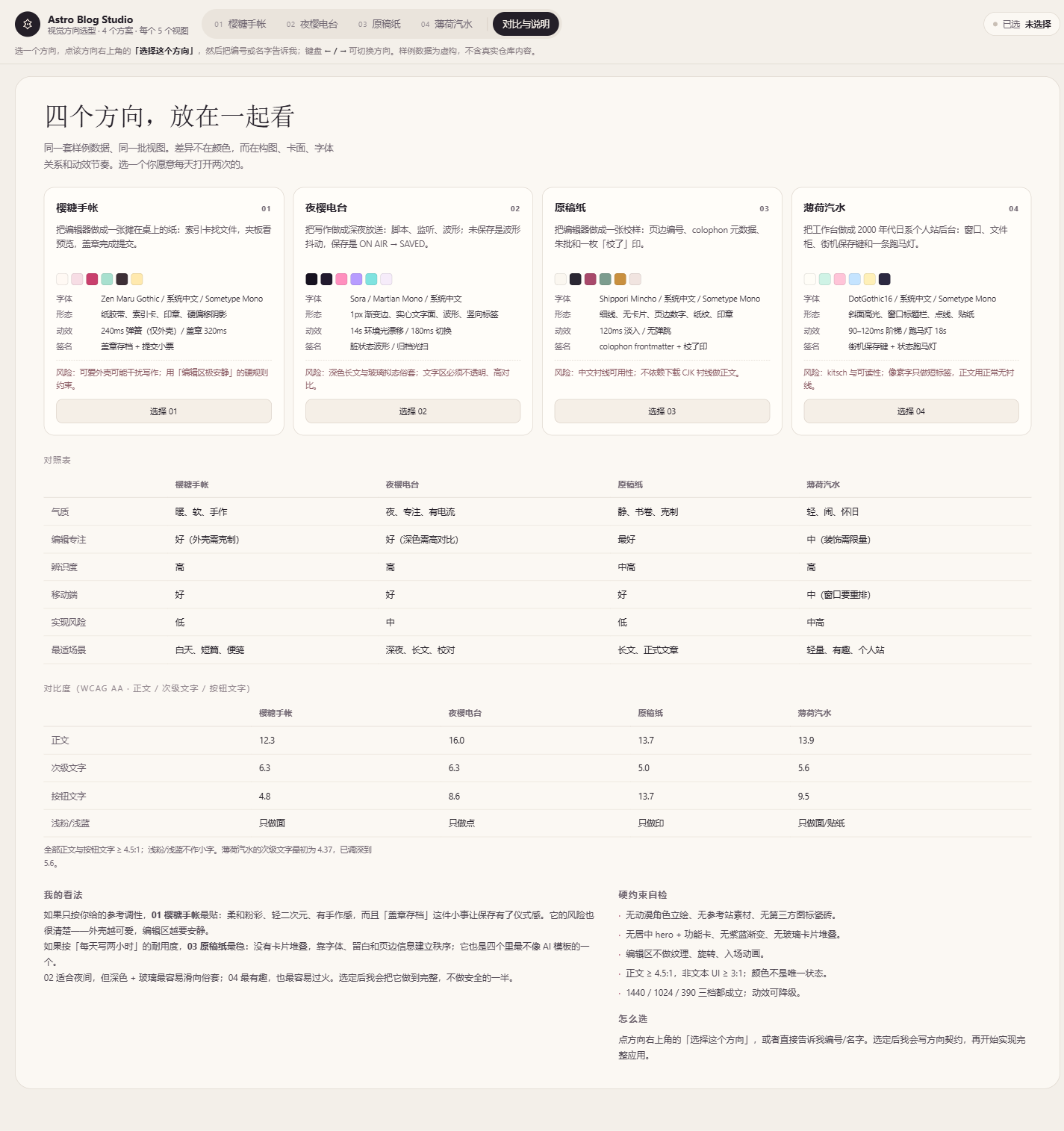
Then I first had it produce four visual directions. I took a liking to No. 01 "Sakura Sugar Journal" at first glance: files are index cards, editing is paper, committing is stamping.
Then came an afternoon plus an evening.
Almost all the code was written by AI. I came up with the requirements, I picked the visual direction, and I also looked through every interface screenshot by screenshot; but as for how it was specifically implemented, I basically didn't bother. My job was more like: make requests, click buttons, and then say "this doesn't look good, change it again."
There was quite a bit of fussing in between too. For example, dark mode wasn't decided on a whim—I first made a separate comparison page, and only then settled on warm ink paper; and PWA, the code was clearly written, but no matter what I did I couldn't see the Service Worker in pnpm dev. After much fussing I finally learned that it simply doesn't register in the dev environment, and you have to build and then preview to verify it.
In the end I also added "local backup." When writing articles, the thing I fear most is accidentally refreshing; now the bottom bar shows "Backed up locally 22
," and after refreshing I can still recover unsaved content, which feels much more reassuring.By 10
PM, after the last commit, I opened the webpage, clicked into an article, changed the title, and clicked "Stamp and Save."Then I went to GitHub to look, and there was one more commit.
That moment felt pretty good.
I also casually published dist/ to sakura.ksable.top. Now, in the classroom, in the dorm, on the road, I can open the webpage and write.
Back to the point: why is it more convenient than the previous Decap:
- No environment setup needed. It's just a pure static webpage, now deployed at sakura.ksable.top. The address is bookmarked in my mobile browser, as handy as scrolling through posts.
- The interface is much prettier. It's not the kind of "good enough to use" CMS backend; it's a sheet of journal paper; and at night there's dark mode.
- It's finally usable on mobile. On the left is a drawer with the file tree, below is the main text, and the stamp button is fixed at the end of the paper.
- Saving is committing. No need to open a terminal, no need to wait for a local build; after editing, click once, and there's one more commit on GitHub.
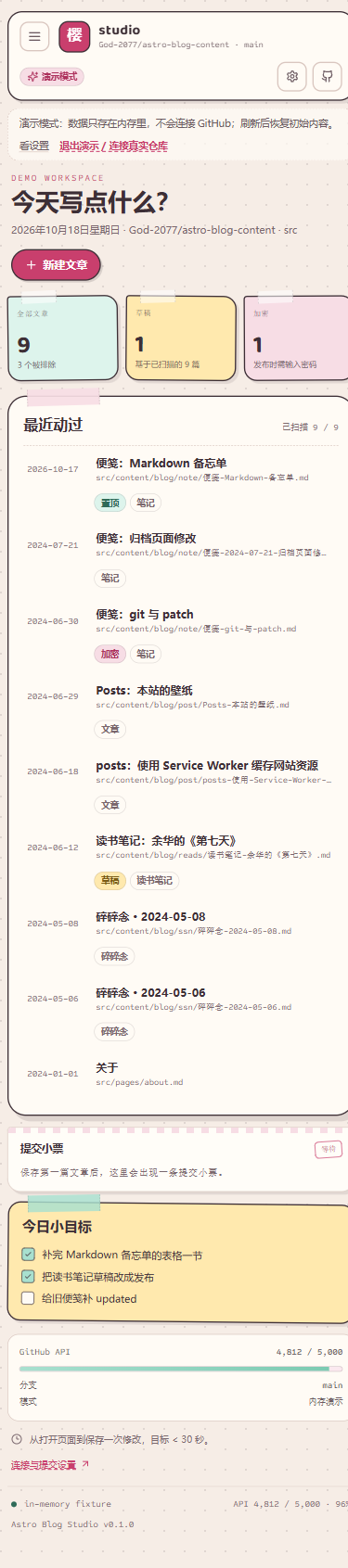
In the future, when I want to post some random musings, I don't have to wait until I get home or until I have time; whatever comes to mind on the road, I can pull out my phone and edit a couple of lines.
But honestly, after finishing this, what struck me most wasn't the interface, but AI.
In the past, when making things, the biggest blocker was "I can imagine it but can't build it": there's a rough shape in my head, but I don't know CSS, I don't know React; I look through docs for ages, write for two days, and end up with something that's neither fish nor fowl.
Now it's different. I just need to explain clearly what I want, and AI can do the rest, and do it better than me.
But after spending this afternoon on it, I also realized: AI can write the code for me, but it can't make decisions for me.
What kind of interface counts as good-looking, which interaction is handy, where to cut corners, where something must stay—no one can think about these for me. Today's 16 commits, every single one was approved by me.
So after the barrier is lowered, what's truly difficult is actually another thing: what exactly do you want?
By the time I finished writing this, it was almost midnight; I have class tomorrow, so I'm going to sleep first.
I should be able to update my blog more diligently from now on... Let me set a flag first—don't let next month be another month without updates.
Live URL: https://sakura.ksable.top/
Project URL: God-2077/astro-blog-studio
If you enjoyed this, leave a comment~